Engineering
Building Yata: A Translation App in a Couple of Evenings
How I used SvelteKit, Cloudflare, and an issue-by-issue Codex workflow to build a focused translation app, then changed models when latency broke the experience.
I had already entered my text into DeepL when a Cloudflare Turnstile checkbox appeared over the page. It had given me enough time to start, but now I could not copy the Translation or interact with the interface until I passed the check.
That interruption was one part of an accumulated frustration with translation products. DeepL also appended a promotional attribution when I copied longer Translations from its free version. Kagi Translate did not focus the textarea when I opened it, even though the textarea is the product's main interaction, and Kagi later paused free access. Google Translate was easy to reach, but its results often lacked the contextual quality I wanted.
None of those observations is a market analysis, and this is not a comparison of translation services. They simply pushed me toward a personal question: what would a translation product look like if I built the one I wanted to use myself?
Translation should not feel like work
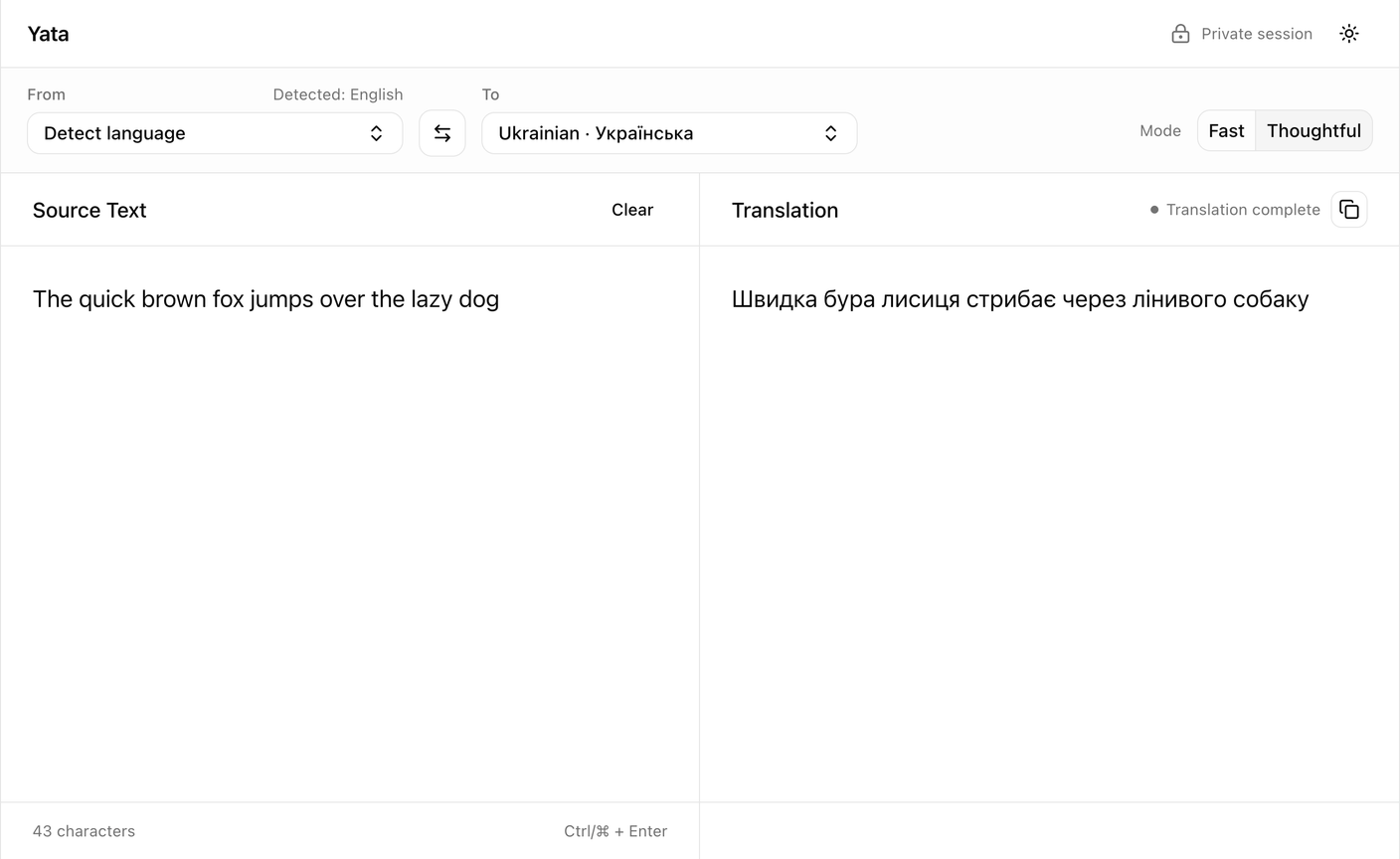
The obvious modern answer would have been to use an AI chatbot. I did not want another chat. Translation does not need a conversation, a message history, or context that carries from one request into the next. Each Translation Request should stand on its own: Source Text, language choices, and the selected Translation Mode go in; a read-only Translation comes back.
That decision made the interface deliberately conventional. Yata has two text areas, language
selectors, a Copy action, and little else competing for attention. The Source Text editor is
focused when the desktop app opens. Live Translation begins after a short pause, while
Ctrl+Enter or Command+Enter starts it immediately. The result is designed to let me paste,
translate, and copy without leaving the keyboard.
The product still needed to handle the less visible parts of that simplicity. If I change the Source Text while a request is running, the old request becomes obsolete. If I change a language or switch between Fast and Thoughtful Translation, the visible result is now out of date. If the replacement fails, discarding the previous successful Translation would turn a recoverable failure into lost work.
I modeled those cases as one discriminated lifecycle rather than a collection of flags: idle, debouncing, translating, current, out of date, and failed. The previous Translation can remain visible while its status tells the truth. A 600-millisecond debounce keeps ordinary typing from issuing a request for every edit, and input-method composition is allowed to finish before that timer starts.
Cancellation is only best-effort, so the browser also owns a monotonically increasing sequence. An obsolete request may still finish somewhere downstream, but it cannot publish over newer work. The essential shape looks like this, trimmed for the article:
function cancelObsoleteWork(): void {
  requestSequence += 1;
  activeAbortController?.abort();
  activeAbortController = undefined;
}

async function publishTranslation(
  sequence: number,
  abortController: AbortController,
  translationRequest: TranslationRequest,
): Promise<void> {
  const result = await request(translationRequest, abortController.signal);

  if (sequence !== requestSequence) return;

  lastSuccessful = { request: translationRequest, result };
  lifecycle = { status: 'current', success: lastSuccessful };
}
This was the first point where the product philosophy became an engineering constraint. "Immediate" was not a visual style. It depended on scheduling, cancellation, state ownership, and eventually the latency of the model itself.
Privacy followed the same product-first logic. Yata retains no Translation history or content logs, and it disables AI Gateway payload logging and caching. A provider necessarily receives the Source Text, but Yata sends no application account, Cloudflare Access identity, analytics identifier, or conversation history with it. Under Google's paid-service terms, those requests are not used to improve Google's products, although Google may still retain content for abuse monitoring. I describe Yata as private, not as zero-retention. The distinction matters, but privacy is a supporting property of the product rather than the subject of this case study.
An unfamiliar frontend on familiar infrastructure
I came to Yata with more than seven years of frontend experience, mostly in Vue and React. Before this project, I had built only something very basic with Svelte. Yata became my first substantial SvelteKit application.
I had been curious about Svelte for a long time. As Vue's Vapor Mode moved toward a compiler-driven, no-virtual-DOM rendering path, I wanted to experience those ideas from the other direction: start with a framework built around compilation and see how they felt in a complete product.
The transition was much smoother than the word "new" suggests. Component composition, reactive state, and the separation between application behavior and presentation all transferred naturally from Vue. Svelte's compiler-first model kept the resulting client lightweight, and Svelte 5 runes gave the translator controller an explicit place to own reactive state without adding a state library.
Codex also handled Svelte and SvelteKit well. That does not prove that every unfamiliar framework becomes effortless with an AI coding partner, but it changed the risk calculation for this project. I could review the logic and patterns through the frontend experience I already had while Codex supplied much of the framework-specific implementation. The resulting application still felt snappy and native to the stack rather than like Vue code mechanically translated into Svelte.
For infrastructure, I chose the familiar option. Cloudflare Workers was already a platform I knew, and a single SvelteKit Worker was a good fit for a small full-stack application: static application shell, dynamic Translation endpoint, secrets, deployment, and owner-only Access protection in one place.
The pleasant discovery was Cloudflare AI Gateway. It gave both inference paths one place for metadata-only observability, rate limiting, authentication, and cache controls. Its core analytics, caching, and rate-limiting features are currently free, although provider inference still has its own price. For developers who already use Cloudflare, AI Gateway is remarkably easy to recommend: it adds useful control without requiring a large AI framework or a separate operational system.
The integration does not mean every request remains inside Cloudflare. Fast Translation uses a Cloudflare-hosted model, while Thoughtful Translation passes through AI Gateway to Google. What stays unified is the Cloudflare account, request path, and operational controls—not the underlying provider.
Responsiveness runs through the whole stack
Yata exposes two Translation Modes. Fast is for ordinary requests where latency matters most. Thoughtful permits additional provider reasoning for harder text while preserving exactly the same interface and browser-visible response contract.
The first version used Cloudflare-hosted Gemma 4 for both. That was a reasonable starting point, not an architecture I needed to apologize for later. One model meant one Workers AI binding, one Gateway, no third-party inference credential, and no speculative provider layer. Fast disabled thinking; Thoughtful asked Gemma to reason briefly before publishing the structured Translation.
Then I watched Thoughtful requests in Chrome's Network panel. For comparable short Source Text, they took approximately five seconds end to end. The request worked, but the pause dominated an interaction designed to disappear into my typing flow.
I first tried the smaller change: constrain Gemma to LOW reasoning and ask it to use only the minimum thought needed to resolve ambiguity. The wait did not materially improve. At that point the question was no longer how to tune one model. It was whether the simplicity of one inference stack was worth keeping when it contradicted the product.
I considered Gemini 3.5 Flash, Gemini 3.6 Flash, Qwen, and several other models before choosing Gemini 3.5 Flash-Lite with low thinking for Thoughtful Translation. Its combination of speed, cost, structured output, and paid-provider data terms fit Yata best. Fast remained on Gemma because its path did not have the same problem.
The switch revealed differences a model string could not hide. Workers AI publishes through one forced tool call; Gemini returns native JSON-schema output. They have different reasoning controls, authentication, token accounting, and error shapes. Those were the variations that finally justified a boundary:
export type ProviderTranslationRequest = Omit<TranslationRequest, 'mode'>;

export interface TranslationProvider {
  model: string;
  pricing?: ProviderPricing;
  translate(
    request: ProviderTranslationRequest,
    promptVersion: string,
    signal: AbortSignal,
  ): Promise<ProviderPublication | undefined>;
}
The interface is intentionally narrow. It does not promise arbitrary portability or expose a provider selector. Fast always names one configured path and Thoughtful names the other. The Translation Service continues to own the stable product contract: validation, deadlines, language policy, safe errors, request IDs, and content-free diagnostics. Provider-specific adapters remain concrete behind it.
Using the same informal Network-panel method and comparable text, I now see Thoughtful responses around one second. In one five-request capture, every request completed between 874 milliseconds and 1.35 seconds:
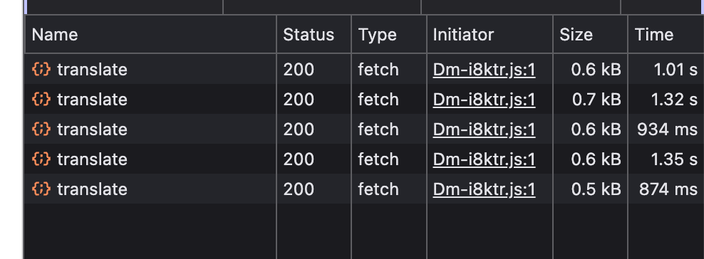
That is enough to change the feel of the product. It is not a controlled benchmark: I did not record a fixed corpus, sample size, cold-versus-warm runs, or a breakdown of browser, network, Gateway, and model time.
The quality result is similarly bounded. I saw no obvious regression for popular languages and noticeably better results for Ukrainian, Hutsul, and Surzhyk, but I have not completed a thorough provider-backed evaluation. Deterministic tests prove that the adapters preserve Yata's structured contract and failure behavior. They do not prove linguistic quality.
That distinction is useful. The model change solved the interaction problem I had observed and made the architecture more honest about its two providers. It did not establish a universal model ranking.
From sixteen issues to a closed beta
The development speed came from making decisions before generating code. I used a grilling workflow from Matt Pocock's skills to force the product questions into the open. The result became a PRD, then sixteen initial vertical slices that Codex could implement one by one.
That sequence mattered. "Build a translation app" leaves hundreds of decisions implicit. An issue such as Live Translation had a much tighter boundary: debounce after 600 milliseconds, respect composition events, cancel obsolete work, and prevent older requests from publishing. The issue described what had to be true; Codex could concentrate on making it true.
I defined the idea, UI/UX philosophy, constraints, and architecture. Codex implemented the application issue by issue. I reviewed every commit—primarily its logic, patterns, and architectural direction—then exercised the result and redirected it when necessary. This was active oversight, although not a meticulous line-by-line review.
The first usable version took shape in a couple of evenings. Deployment, the Gemini migration, and polish continued over the next few days. The repository records the aftermath of the process: one PRD, sixteen initial implementation issues, issue-scoped commits, and verification notes. It does not turn those days into proof that anyone can build any production system instantly. I brought years of frontend judgment, a familiar infrastructure platform, and a deliberately narrow product scope to the work.
I then put Yata in an Access-protected closed beta with three people from my circle of friends and family. The goal was not to validate Translation quality. It was to make the application usable enough for my inner circle before widening access. Their feedback found the kind of problems a product needs real use to expose: labels that felt wrong, sizing inconsistencies, and missing workflow details such as a Clear action. I fixed those issues without changing the basic direction of the product.
Yata is still a small application. It has no conversation, history, database, provider marketplace, or attempt to support every language a model might recognize. That restraint is part of why it works for me.
Three lessons remain after the implementation details. First, chat is not a silver bullet for AI products. A focused task often deserves a focused interface. Second, responsiveness runs through the whole system: component state, request ownership, network behavior, and model choice all shape the same user experience. Third, an AI coding partner can compress implementation dramatically when the product decisions and acceptance boundaries are explicit.
With a narrow problem, explicit product decisions, a familiar deployment platform, and an issue-by-issue AI-assisted workflow, I could build a genuinely usable application in a couple of evenings. That does not remove the need for engineering judgment; it changes where that judgment is spent.